


Most drywall contractors need general liability with completed operations coverage, workers’ compensation once they have employees, commercial auto, and tools and equipment coverage. Contractors on larger commercial jobs usually add umbrella coverage. What it costs depends mainly on payroll, the kind of projects you take, your claims history, and the limits your contracts require.
A drywall contractor’s day starts early and moves fast. You’re hauling sheets, running crews, meeting general contractor deadlines, and sharing a job site with half a dozen other trades. Insurance is the last thing on your mind until the general contractor says your certificate of insurance has expired, someone on your crew gets hurt, or a client blames your work for damage behind a wall.
Key takeaways
- Completed operations coverage matters most, because cracks and tape failures can surface months after a job is done.
- California requires workers’ compensation once you have an employee, and all licensed contractors must carry it starting January 1, 2028.
- Workers’ comp cost is driven by payroll, your job classification, and claims history, then adjusted at the annual audit.
- Collecting certificates of insurance from every subcontractor protects you at claim time and at audit.
Why Drywall Work Carries More Liability Than It Looks
Drywall installation looks simple from the outside, but you work alongside electricians, plumbers, HVAC crews, and framers inside walls and ceilings that will be closed up once the job is done. That creates risks that can follow you long after you’re paid.
Completed Work Claims
Cracks, nail pops, tape failures, and moisture problems can show up months or years after a job is complete, and the general contractor or owner will come back to you. Completed operations coverage, included in most general liability policies, responds to claims that arise after the work is finished. Many general contractors require it to stay in place for a set number of years after a project closes, so a lapse can leave older jobs uncovered.
Injuries on Multi-Trade Job Sites
Drywall work leaves dust, off-cuts, and tools in busy areas. A superintendent trips over a stack of corners, or a client steps on a screw during a walkthrough. On shared sites, general contractors often push responsibility to the sub whose work area was closest, so these third-party injury claims land on your general liability policy.
Crew Injuries
Hanging ceiling board, carrying sheets up stairs, cutting with utility knives, and working on stilts all carry regular injury risk. Back injuries, cuts, and falls are the most common. OSHA’s fall prevention resources cover the ladder, scaffold, and stilt hazards drywall crews face every day.
Subcontractor Liability
If a subcontractor you hire injures someone or leaves defective work, the claim can travel up to you, especially if the sub has no insurance. Our guide to whether subcontractors are covered under your insurance explains how to protect yourself.
Tool and Equipment Theft
Lifts, screw guns, compressors, and finishing tools disappear from job sites regularly. General liability does not cover your own tools, so theft and damage need a separate tools and equipment policy.
What Insurance Do Drywall Contractors Need?
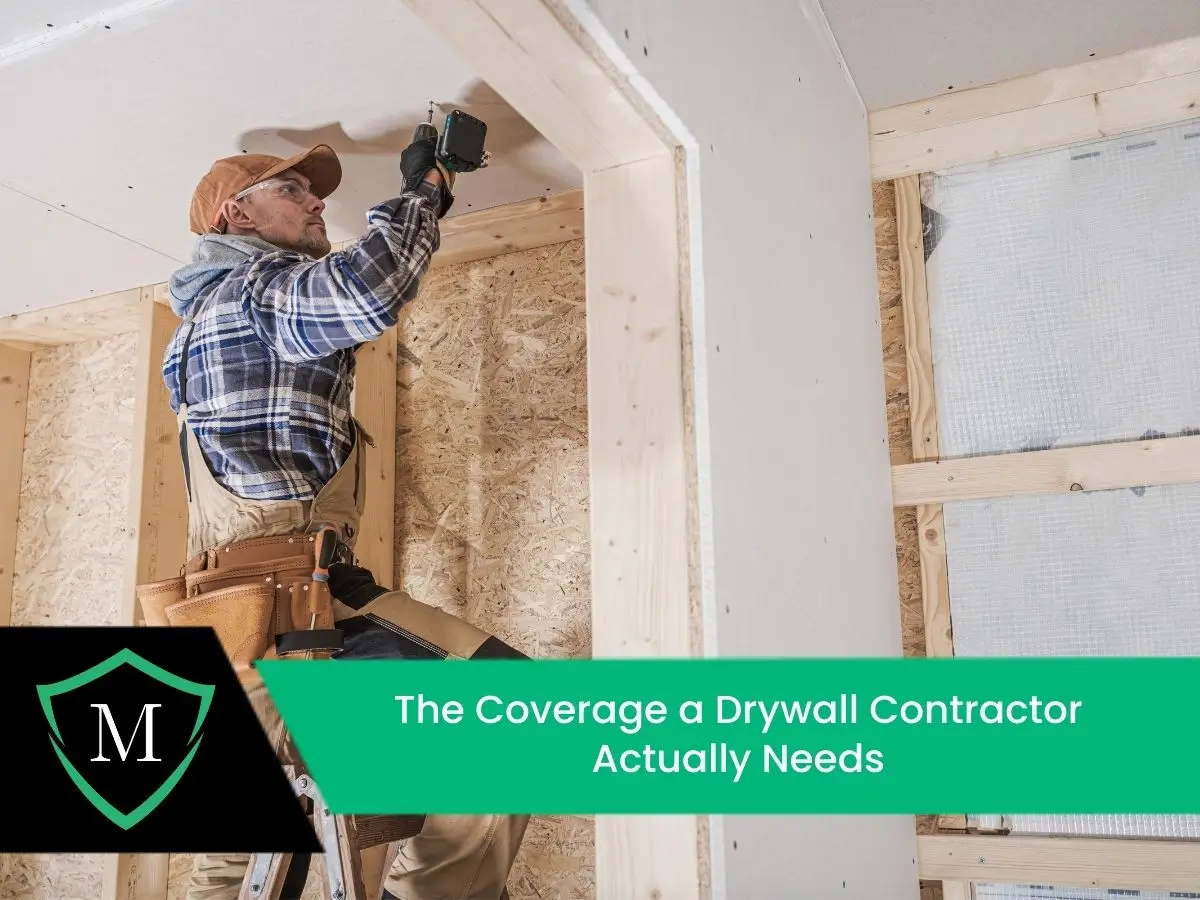
Here is how each policy fits a drywall business and who needs it:
| Coverage | Why drywall contractors need it | Who needs it |
|---|---|---|
| General liability with completed operations | Third-party injuries, property damage, and claims that surface after the job | Every drywall contractor |
| Workers’ compensation | Medical care and lost wages for injured employees | Any contractor with employees |
| Commercial auto | Accidents in trucks and vans used for work | Anyone driving to job sites |
| Tools and equipment (inland marine) | Theft or damage to tools on site, in transit, or in storage | Anyone whose tools would be costly to replace |
| Umbrella or excess liability | Extra limits above general liability and auto | Contractors on commercial or multi-family projects |
| Business owner’s policy | General liability and property bundled together | Smaller operations with a shop or storage space |
General contractors usually set minimum limits in the subcontract and ask for proof through a certificate of insurance, often with additional insured status. Our guide to general contractor insurance requirements shows the limits public agencies commonly require.
California Requirements for Drywall Contractors
- Licensing: drywall work falls under the C-9 Drywall Contractor classification, which covers installing gypsum wallboard and the taping and texturing that finish it.
- Contractor license bond: every licensee needs a $25,000 contractor license bond.
- Workers’ compensation: required once you have an employee, and scheduled for all licensed contractors on January 1, 2028, with or without employees.
- LLC liability: contractors licensed as an LLC must carry at least $1 million in liability insurance, increasing with personnel up to $5 million.
Drywall contractors
Need limits that match your next subcontract?
Get coverage built around your crew, payroll, and contracts, at competitive rates.
How Much Does Insurance Cost for Drywall Contractors?
There is no single price. A one-person residential finisher pays far less than a commercial crew with several trucks, because insurers price each business on its own risk. The biggest drivers are:
- Payroll and crew size: the base for workers’ compensation and a key factor in liability pricing
- Type of work: commercial and multi-family projects usually carry more exposure than residential work
- Claims history: past claims raise premiums, and a clean record helps
- Limits and deductibles: higher limits cost more, and a higher deductible can lower the premium
- Subcontractors: uninsured subs can add premium at audit
For a broader look at liability pricing, see our guide to general liability insurance cost.
How Workers’ Compensation Is Priced
Workers’ comp premiums are calculated from your payroll and the job classification assigned to your work, then adjusted for your claims experience. For context, the California Department of Insurance approved an average advisory pure premium rate of $1.65 per $100 of payroll effective September 1, 2026. That is a statewide benchmark across all classifications, not a drywall rate or a quote.
How the Premium Audit Works
At the end of the policy year, your insurer compares your actual payroll to the estimate used to set the premium. It reviews payroll records, any 1099 payments, and subcontractor certificates. If payroll was higher than estimated, you owe more; if it was lower, you may get money back. Paying a sub who can’t show proof of coverage can also add premium, and calling workers 1099 doesn’t settle the question, as our 1099 vs. W-2 guide explains.
Free coverage review
Check your coverage before your next audit or contract.
- Completed operations
- Additional insured endorsements
- Workers’ comp audit prep
- Subcontractor certificates
What a Claim Looks Like for a Drywall Contractor
A Completed Work Dispute
Eight months after a new home is finished, the owner finds cracking along ceiling seams and tape failures, and an inspector blames the taping technique. The owner names the drywall sub and the general contractor. General liability with completed operations defends the claim and pays any settlement up to the policy limits, minus the deductible. Without it, the contractor pays the repair and legal costs personally.
A Fall From Stilts
A finisher on stilts loses balance on an uneven subfloor and fractures an ankle, needing surgery and weeks off work. Workers’ compensation pays the medical bills and partial lost wages. Without it, the contractor is personally responsible for those costs.
Tool Theft Over a Weekend
A crew stages tools for Monday, and the site is broken into over the weekend. A tools and equipment policy pays replacement cost minus the deductible, and the crew is back to work quickly. Without it, the contractor pays out of pocket or rents equipment while the job waits.
How to Get the Right Coverage Without Overpaying

- Work with a broker who knows contractors. Class codes, subcontractor audit rules, and completed operations requirements are easy to get wrong.
- Report payroll accurately. A realistic estimate avoids a large audit bill later.
- Collect certificates from every sub, every time. No sub works without a current certificate naming you as an additional insured.
- Consider a business owner’s policy if you have a shop or storage space and qualify.
- Review coverage when your business changes, such as adding employees, moving into commercial work, or taking larger contracts.
McDonough Insurance Services works with drywall contractors across California, from owner-operators to firms running multiple commercial projects. When you’re ready to compare options, explore our drywall contractor insurance coverage.