
When a client, contractor, landlord, or business partner asks for a certificate of liability insurance, they usually want proof that your business carries the insurance required for the relationship. A certificate summarizes important information such as the insured business, insurer, coverage limits, and policy dates.
A COI makes insurance verification easier, but it is not the insurance policy itself. It also does not automatically give coverage to everyone named on the document. Understanding what a certificate shows, who the certificate holder is, and how it relates to your actual policy can help prevent contract delays and costly misunderstandings.
What Is a Certificate of Liability Insurance?
A certificate of liability insurance is a document used to provide evidence of certain business insurance coverage. It is commonly requested before a company begins work for a client, enters a commercial lease, joins a construction project, or signs a contract with another business.
Rather than asking the other party to review an entire insurance policy, a certificate provides a convenient summary of the information most relevant to the business relationship.
A Simple Explanation of a Certificate of Insurance
Think of a COI as a snapshot of selected insurance information. It can identify the insured business, insurance company, policy number, coverage type, limits, and policy period.
This is why businesses often use a COI as proof of liability insurance. A general contractor, for example, may request one from a subcontractor before allowing work to begin.
The important distinction is that the certificate summarizes information; it does not establish the complete scope of coverage. The actual policy contains the terms, conditions, exclusions, and endorsements that determine how coverage applies.
What Information Does a Certificate of Liability Insurance Include?
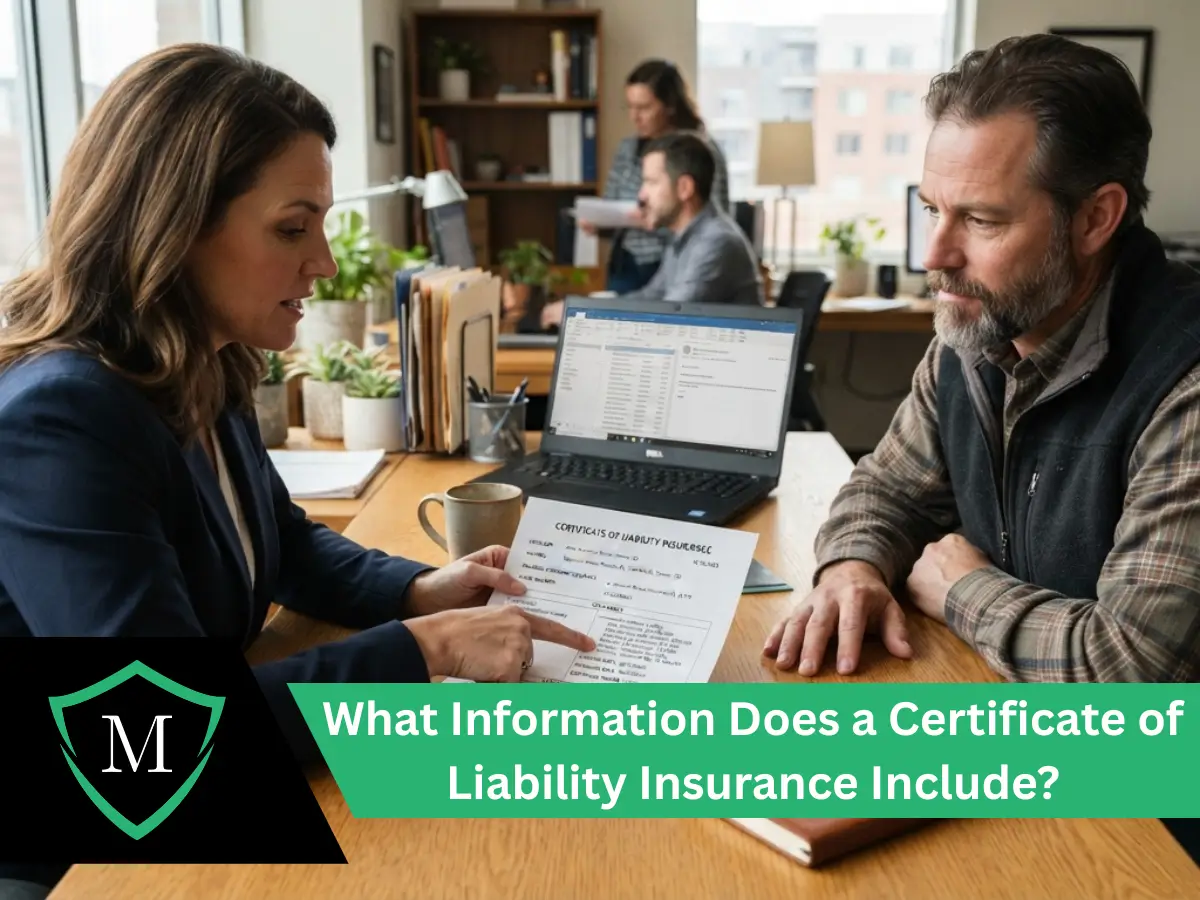
A certificate is designed to put essential insurance details into an easy-to-review format. The information can vary depending on the policies involved, but several details are particularly important.
The document generally identifies the named insured, insurance carrier, policy numbers, coverage types, limits, and effective dates. It may also identify the certificate holder and provide information about a particular project or location.
Named Insured and Insurance Carrier
The named insured is the business or individual whose insurance is being documented. This should match the entity that actually owns the policy.
The insurance carrier identifies the company providing the coverage. The certificate may also include information about the insurance producer or agency.
These details matter when a business operates under more than one legal name. If a contract identifies ABC Construction LLC but the certificate shows a different entity, the requesting party may question whether the document satisfies the agreement.
Coverage, Limits, and Policy Dates
A certificate can show the types of coverage carried and the applicable limits. General liability is one of the most common coverages requested from businesses.
The effective and expiration dates are equally important. A certificate showing an expired policy period may not satisfy a current contract, even if the business has since renewed its insurance.
Depending on the company, a certificate may also show commercial auto, workers’ compensation, professional liability, umbrella, or excess coverage.
The certificate provides a useful summary, but it does not explain every limitation or exclusion in the underlying policy.
What Is a Certificate Holder for Insurance?
A certificate holder is generally the person or organization receiving the certificate as evidence that another party has insurance.
For example, a property owner may require a contractor to provide a certificate before allowing work at a building. The property owner can be identified as the certificate holder on the document.
The terminology can create confusion because being listed as a certificate holder does not automatically make that person or organization an insured under the policy.
Certificate Holder vs. Additional Insured
Certificate holder and additional insured are different concepts.
| Certificate Holder | Additional Insured |
| Receives the insurance certificate | May receive certain coverage rights under the policy |
| Does not automatically receive coverage | Coverage depends on applicable policy language or endorsement |
| Primarily relates to insurance documentation | Relates to rights under the insurance policy |
| Common for clients, landlords, and contractors requesting proof | Common when a contract requires another party to receive protection |
A certificate holder receives documentation about the insured’s coverage. An additional insured may have certain rights under that coverage when the policy provides them.
If a contract requires additional insured status, simply putting that party’s name on the certificate is not enough. The applicable policy language or endorsement needs to support the requested status.
The National Association of Insurance Commissioners explains that an endorsement can modify an insurance policy by adding, changing, restricting, or excluding coverage.
What Does a Certificate of Liability Insurance Actually Prove?
A COI provides evidence of selected insurance information for the policy period shown. It allows a client or other interested party to quickly verify basic details without reviewing the entire insurance contract.
But there is an important limitation:
A certificate is evidence of insurance, not the insurance policy itself.
The underlying policy determines whether a particular claim is covered. Definitions, exclusions, conditions, limits, and endorsements can all affect coverage.
For example, seeing a general liability limit on a certificate does not mean every type of loss involving the business is covered. The policy’s actual wording determines what falls within coverage.
The same principle applies to additional insured requirements. A certificate cannot create coverage that the underlying policy does not provide.
What Are Common COI Requirements?
Insurance requirements usually come from a contract, lease, project agreement, or another business arrangement. There is no single set of requirements that applies to every company.
A client may require general liability coverage at a particular limit. A construction agreement might also require additional insured status or other policy provisions.
General Liability Coverage and Limits
General liability is commonly requested because businesses can face claims involving third-party bodily injury, property damage, and other covered liability exposures.
The SBA lists general liability among common types of business insurance and notes that it can address certain financial losses associated with bodily injury, property damage, lawsuits, and related exposures.
A contract might require a specific per-occurrence limit and aggregate limit. Those amounts can then be shown on the certificate for the requesting party to review.
Additional Insured and Other Requirements
Some agreements go beyond liability limits. They may require additional insured status, specific endorsements, waiver provisions, or other insurance conditions.
These requirements should be compared with the actual policy rather than assumed to be satisfied because a certificate was issued.
If a contract contains detailed insurance requirements, giving the entire request to your insurance professional is usually more useful than simply asking for a generic certificate.
How Do You Get a Certificate of Insurance?
Most businesses request a certificate through their insurance agent, broker, or carrier.
When making the request, provide the exact information supplied by the party requesting the document. This can include the certificate holder’s legal name and address, project details, required limits, and any special insurance provisions.
If the contract requires additional insured status, mention it specifically. Your insurance professional can determine whether the current policy already meets the requirement or whether an endorsement is necessary.
Requesting the certificate early can also prevent unnecessary delays. A standard certificate may be straightforward to issue, while a request involving a policy change or endorsement may require additional review.
ACORD maintains insurance industry forms and standards used by insurance professionals, including commonly used certificate forms.
How Should You Review a Certificate of Liability Insurance?
Do not assume a certificate is correct simply because it came from an insurance professional. Compare it with the requirements you received.
First, check the named insured and make sure the legal business name matches the contract. Then review the insurance carrier, policy numbers, coverage types, limits, and effective dates.
Next, check the certificate holder’s name and address. A simple spelling or entity-name error can cause a client to reject the document.
Finally, review any special requirements involving additional insured status or endorsements. If something is unclear, ask your insurance professional to verify it rather than making assumptions based on the certificate alone.
COI Example: How a Certificate Works in Practice
Imagine a plumbing contractor has been hired for a commercial renovation. Before work begins, the property owner requests evidence of liability insurance.
The contractor sends the owner’s insurance requirements to its agent. The resulting certificate identifies the contractor, insurer, liability coverage, limits, and policy period.
The property owner compares those details with the contract. If the agreement requires a higher liability limit than the contractor carries, the problem can be identified before work starts.
If the contract also requires the property owner to be an additional insured, the insurance professional must verify that the applicable policy provision or endorsement provides that status.
This illustrates the real value of a COI: it helps businesses verify documentation before an insurance requirement becomes a project problem.
Common Mistakes Businesses Make With Certificates of Insurance
One common mistake is treating the certificate as if it were the policy. It is only a summary of selected insurance information.
Another is assuming that a certificate holder automatically has coverage. Certificate holder status and additional insured status are not interchangeable.
Businesses also sometimes submit outdated certificates. A policy may have renewed or changed since the last certificate was issued.
Another mistake is focusing only on the liability limit. A policy can have the requested limit while still needing a specific endorsement or other provision to satisfy a contract.
Reviewing the certificate against the actual contract can help identify these issues before they cause delays.
Why Keeping Your Certificate Current Matters
A certificate represents insurance information for a particular policy period. When your policy renews or your coverage changes, an older document may no longer represent your current insurance.
This matters especially for contractors and service businesses that work with multiple clients. Each client may also have different requirements.
Keeping current certificates available can make it easier to respond when a new project begins. However, maintaining the document should go hand in hand with reviewing whether the underlying coverage still matches your business.
The SBA recommends reassessing business insurance as a company grows because changes in operations, equipment, employees, and other circumstances can affect insurance needs.
Does a Certificate of Liability Insurance Guarantee Coverage?
No. A certificate does not guarantee that a particular claim will be covered.
It provides evidence of selected insurance information, while the actual policy determines coverage.
Policy exclusions, conditions, definitions, limits, and endorsements can all affect whether a particular loss is covered. A certificate also cannot create coverage simply because a party’s name appears on the document.
When a contract has important insurance requirements, the safest approach is to compare those requirements with the actual policy and endorsements.
If something is unclear, an insurance professional can help determine what the policy provides and whether additional documentation or a policy change may be needed.
Final Thoughts
A certificate of liability insurance is a practical document that helps businesses demonstrate their insurance to clients, contractors, landlords, and other organizations. It provides a convenient summary of important information without requiring someone to review an entire insurance policy.
The process is easiest when you understand the relationship between the contract, the policy, and the certificate. Start by identifying what the contract requires. Then confirm that your insurance addresses those requirements before requesting the certificate.
Most importantly, remember that a COI is evidence of insurance, not a replacement for the policy. A certificate holder is not automatically insured, and a certificate cannot create coverage that does not exist under the underlying policy.
If your business needs help reviewing liability coverage or understanding insurance requirements for a contract, McDonough Insurance Services can help you evaluate the coverage behind the documentation and determine whether your insurance aligns with your business needs.
Frequently Asked Questions
What does COI mean in business?
COI stands for Certificate of Insurance. Businesses use it to provide another party with a summary of important insurance information, including coverage, limits, and policy dates.
How do I get a certificate of insurance?
You can request one through your insurance agent, broker, or carrier. Provide the requesting party’s exact information and any insurance requirements included in the contract.
What is a certificate holder for insurance?
A certificate holder is the person or organization receiving the certificate as evidence of another party’s insurance. Being listed as a certificate holder does not automatically provide coverage.
Is a certificate holder the same as an additional insured?
No. A certificate holder receives the certificate, while an additional insured may receive certain rights under the policy when applicable policy language or an endorsement provides coverage.
What is a certificate of liability insurance form?
It is a document used to present selected information about business insurance, including the insured, insurer, coverage types, limits, and policy period.
Can a COI replace an insurance policy?
No. A COI summarizes selected information. The actual policy establishes the terms, conditions, exclusions, limits, and coverage.
What should I check on a COI?
Check the insured business name, insurer, policy dates, coverage types, limits, certificate holder information, and any special requirements listed in the contract.