
Usually, no. A subcontractor is not automatically covered under a general contractor’s insurance policy simply because the subcontractor is hired to work on the contractor’s project. In most cases, the subcontractor operates as a separate business and needs insurance that protects its own operations.
The exact answer depends on the policy language, the contract between the parties, the type of work being performed, and applicable state requirements. A subcontractor may receive limited protection through specific policy provisions or endorsements, but that coverage should never be assumed without reviewing the actual insurance documents.
This distinction is important because a subcontractor’s mistake can create financial exposure for several parties. A damaged building, jobsite injury, construction defect, or third-party claim may involve the subcontractor, general contractor, property owner, and other businesses working on the project.
Why Subcontractors Usually Need Their Own Insurance
A subcontractor is generally an independent business hired to perform a specific portion of a larger project. An electrician, plumber, roofer, painter, HVAC contractor, or drywall contractor may all work as subcontractors while maintaining their own business operations.
Because the subcontractor is a separate business, it will typically need its own insurance coverage. The general contractor’s commercial liability policy is designed primarily around the contractor’s own operations and does not automatically provide complete protection to every independent business hired for a project.
Insurance also helps separate responsibility between the businesses involved. If a subcontractor causes covered property damage or bodily injury through its operations, the subcontractor’s own liability policy may provide a source of defense and indemnification, subject to the policy terms.
Without appropriate coverage, the subcontractor may have to pay legal expenses, settlements, or judgments from business assets. The general contractor may also face additional exposure depending on the circumstances of the claim and the responsibilities created by the contract.
Does a Contractor’s General Liability Policy Cover Subcontractors?
A contractor’s general liability policy generally does not automatically provide full coverage to subcontractors. Whether a subcontractor receives any protection depends on the specific policy wording, endorsements, and relationship between the parties.
Some policies may contain provisions that address certain subcontractor exposures, while others may require subcontractors to maintain their own insurance. The presence of a subcontractor on a jobsite alone does not mean that the subcontractor is insured under the general contractor’s policy.
This is why contractors should review their policy before assuming that all businesses working under them are protected. A misunderstanding about coverage can become especially costly after an accident, property damage claim, or lawsuit.
The contract may also require a subcontractor to carry its own liability insurance and name the general contractor or project owner as an additional insured. That arrangement may provide certain protections, but the scope of coverage depends on the applicable endorsement and the facts of the claim.
What Is Subcontractor Liability Insurance?
Subcontractor liability insurance generally refers to coverage designed to protect a subcontracting business from certain claims arising from its operations. Commercial general liability insurance is often the core policy used to address third-party bodily injury, property damage, and certain personal and advertising injury claims.
For example, a plumbing subcontractor could accidentally cause water damage while installing piping. An electrical subcontractor could cause a fire because of an alleged installation error, while a roofing subcontractor could face a claim after property is damaged during construction.
Whether a particular incident is covered depends on the actual policy terms. Exclusions, limits, deductibles, endorsements, and the circumstances surrounding the claim can all affect how coverage responds.
The key point is that liability insurance is designed to address specific covered risks, not every loss a subcontractor may experience. A subcontractor may need additional policies for employee injuries, commercial vehicles, tools, equipment, professional services, or other exposures.
What Insurance Does a Subcontractor Typically Need?

The right insurance program depends on the subcontractor’s trade, business structure, employees, vehicles, equipment, contracts, and the risks associated with the work. A solo subcontractor performing low-risk work may have different needs from a construction company with employees and expensive equipment.
There is no universal insurance package that applies to every subcontractor. The coverage required by a general contractor may also be different from the minimum coverage required by state law.
General Liability Insurance
General liability insurance is commonly the foundation of insurance for subcontractors. It may respond to covered claims involving third-party bodily injury, property damage, and certain other liability exposures arising from business operations.
A subcontractor could face a claim if a customer’s property is damaged during work or if another person is injured because of an alleged condition connected to the subcontractor’s operations. The policy may provide defense and other covered benefits, subject to its terms.
General liability insurance does not cover every type of business risk. Damage to the subcontractor’s own property, employee injuries, professional errors, pollution exposures, and certain faulty-work claims may require separate coverage or may be subject to policy exclusions.
Workers’ Compensation Insurance
A common question is whether a subcontractor needs workers compensation insurance. The answer depends on factors such as whether the subcontractor has employees and the laws that apply in the state where the work is performed.
Many states require employers to carry workers’ compensation coverage once specific employee or business thresholds are met. Construction businesses may also face additional rules that affect how workers are classified and when coverage is required.
A subcontractor should not assume that the general contractor’s workers’ compensation policy covers its employees. If the subcontractor has employees, the subcontractor may have its own obligations as an employer.
Worker classification can also be complicated. The IRS explains that the actual relationship between a business and a worker matters when determining whether the worker is an employee or independent contractor, rather than relying only on the label used in an agreement. IRS guidance on employee and independent contractor classification
Commercial Auto Insurance
A subcontractor that uses trucks, vans, or other vehicles for business purposes may need commercial auto insurance. Personal auto insurance may not provide the protection needed when a vehicle is primarily used for business operations, transporting tools, or carrying materials.
The insurance requirements may also be specified in the subcontract. A general contractor or project owner may require certain liability limits before allowing a subcontractor to begin work.
Tools and Equipment Coverage
Subcontractors often own valuable tools, machinery, and specialized equipment needed to perform their work. General liability insurance is not automatically designed to cover every loss involving the subcontractor’s own business property.
Depending on the equipment and how it is used, commercial property or inland marine coverage may be appropriate. A contractor transporting tools between jobsites may have different insurance concerns from a business that keeps most equipment at a permanent location.
Professional Liability Insurance
Some subcontractors provide professional advice, design, engineering, consulting, or other specialized services in addition to physical work. Those businesses may face claims alleging errors, omissions, or negligent professional advice.
Professional liability insurance may address certain risks that general liability insurance does not. The appropriate coverage depends on the nature of the professional service and the policy wording.
What Happens If a Subcontractor Does Not Have Insurance?
If a subcontractor has no insurance, the financial consequences can affect more than the subcontractor alone. The business may be unable to meet the requirements of its contract and could be removed from a project before work begins.
The subcontractor may also be personally responsible for legal defense costs, settlements, or judgments if a claim arises and no applicable insurance is available. For a small business, a single serious claim can create significant financial pressure.
A general contractor may also face additional exposure if the subcontractor causes an accident or damage. Whether the contractor is ultimately responsible depends on the facts, the contract, applicable law, and the conduct of each party.
This is why a subcontractor’s lack of insurance should not be treated as a minor paperwork issue. Insurance verification is part of managing the financial risks created when multiple independent businesses work on the same project.
Why Contractors Request Certificates of Insurance
A certificate of insurance, commonly called a COI, is often used to provide evidence that a subcontractor has certain insurance coverage. It may show the insurer, policy dates, coverage types, policy limits, and the insured business name.
A COI can help a contractor determine whether a subcontractor appears to meet the basic insurance requirements of a contract. It also creates a record that insurance information was requested and reviewed before work began.
However, a certificate of insurance is not the same as the actual insurance policy. It does not change the policy terms or guarantee that a particular claim will be covered.
If a contract requires additional insured status, waiver of subrogation, or specific coverage wording, the contractor may need to verify the relevant endorsements. A certificate alone may not provide enough information to confirm that those requirements have been satisfied.
What Should Contractors Check Before Hiring a Subcontractor?

The insurance review process should begin before the subcontractor starts work. The written agreement should identify the required types of coverage, minimum limits, policy duration, and any special endorsements required for the project.
The contractor should then request current insurance documentation and compare it with the contract requirements. The business name, policy dates, coverage types, and limits should be reviewed carefully.
Expiration dates deserve particular attention on long-term projects. A subcontractor may have valid coverage when hired but allow the policy to expire several months later.
For higher-risk projects, reviewing relevant endorsements may be more useful than relying solely on a certificate of insurance. The goal is to confirm that the subcontractor’s coverage is appropriate for the actual work being performed.
Can a General Contractor Be Responsible for a Subcontractor’s Mistake?
Potentially, yes. A subcontractor may be responsible for its own negligent work, but the general contractor can still face allegations involving project management, supervision, contractual duties, or other conduct.
The outcome depends on the facts of the claim, the relationship between the parties, the contract, applicable state law, and the specific actions of each business. Insurance coverage and legal liability are also separate questions.
For example, a subcontractor may perform defective work, while the general contractor may face a separate allegation that it failed to properly manage or supervise the project. The insurance response may differ for each party.
This is why insurance should be part of a broader risk-management process. Written contracts, proper worker classification, jobsite safety, insurance verification, and appropriate supervision all work together to reduce avoidable exposure.
Are Subcontractor Insurance Requirements the Same in Every State?
No. Subcontractor insurance requirements can vary significantly depending on the state, the type of work, the business structure, and the specific project contract. A requirement that applies to one construction business may not apply to another subcontractor performing different work in a different location.
State laws may establish requirements for workers’ compensation, contractor licensing, and worker classification. In addition, private contracts can require insurance limits and endorsements that go beyond the minimum required by law.
This is particularly important for construction businesses working across state lines. A subcontractor may need to review the requirements applicable to the location where the work is actually being performed rather than relying on the rules that apply to its home state.
California businesses should pay close attention to worker classification and workers’ compensation rules. The California Department of Industrial Relations provides information about workers’ compensation and employer responsibilities that can help businesses understand the regulatory framework. California Department of Industrial Relations Workers’ Compensation
Why Contract Requirements Can Be Stricter Than Legal Requirements
A subcontractor may legally be able to operate with a particular level of insurance, while a general contractor requires higher limits under the contract. These are separate issues and should not be confused.
For example, a project owner may require a general contractor to carry specific liability limits. The general contractor may then require subcontractors to maintain certain limits and endorsements to help satisfy contractual obligations.
The contract may also require the subcontractor to provide additional insured coverage, primary and noncontributory wording, or a waiver of subrogation. These requirements can affect how insurance policies interact when a claim involves multiple businesses.
A subcontractor should review the insurance section of every significant contract before agreeing to the work. The coverage required for one project may be different from the requirements of another customer.
What Does Additional Insured Status Mean for a Contractor?
A general contractor or project owner may require a subcontractor to add them as an additional insured on the subcontractor’s liability policy. This may provide certain protection for covered liability connected to the subcontractor’s operations.
However, additional insured status does not mean that the general contractor receives unlimited access to the subcontractor’s entire insurance policy. The scope of protection depends on the specific endorsement and the circumstances of the claim.
Some endorsements may apply only to ongoing operations, while others may address completed operations. The wording may also limit coverage to liability arising from the subcontractor’s acts or omissions.
For this reason, a contractor should not rely only on the words “additional insured” appearing on a certificate. The actual endorsement can determine what protection is available.
What Is the Difference Between a COI and an Insurance Policy?

A certificate of insurance is evidence that certain coverage appears to exist at the time the certificate is issued. The insurance policy is the actual contract that establishes the coverage, exclusions, conditions, limits, and other terms.
This difference matters when a contractor has specific insurance requirements. A COI may show that a subcontractor has general liability insurance, but it may not show every exclusion or endorsement affecting a potential claim.
A certificate also does not create coverage that the policy does not provide. If the underlying policy excludes a particular type of risk, a certificate cannot override that exclusion.
For routine verification, a COI can be useful. For complex or higher-risk projects, reviewing the actual policy provisions and endorsements may provide a more accurate understanding of the protection available.
Can a Contractor Rely Only on a Subcontractor’s Certificate of Insurance?
Not always. A COI is an important document, but it should be treated as one part of the insurance verification process rather than a complete substitute for reviewing coverage.
The contractor should compare the certificate with the written contract and confirm that the named business, coverage dates, policy limits, and insurance types match the project requirements. Any special contractual requirements should also be addressed.
If the project involves significant liability or unusual risks, the contractor may need additional documentation. This could include relevant endorsements or confirmation from the subcontractor’s insurance professional.
The more complex the project, the more important it becomes to verify that the insurance arrangement matches the actual risks. A certificate that appears acceptable at first glance may not answer every coverage question.
How Contractors Can Reduce Subcontractor Insurance Risks
The most effective approach is to create a consistent process for every subcontractor. Insurance requirements should be established before work begins rather than addressed only after an accident occurs.
The contractor should identify the required coverage, limits, and endorsements in the written agreement. The subcontractor should then provide current documentation that can be compared with those requirements.
Insurance verification should also continue throughout longer projects. Policies expire, businesses change insurers, and the scope of work may expand after the original agreement is signed.
A consistent process can help contractors identify problems earlier. It also creates better documentation showing that insurance requirements were considered as part of the project’s risk-management process.
Why Subcontractor Insurance Should Be Reviewed Before the Job Starts
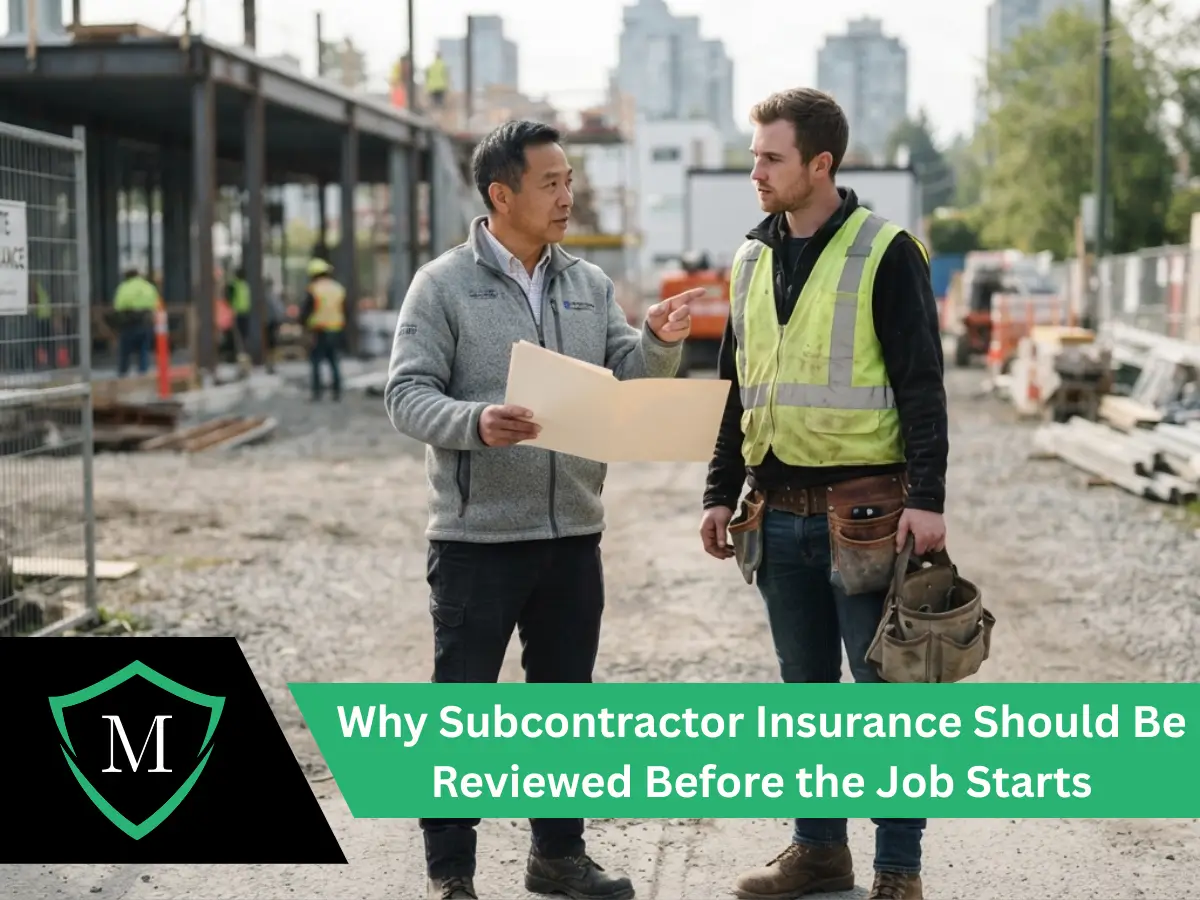
Waiting until a claim occurs is one of the worst times to discover that a subcontractor lacks the required coverage. By then, the parties may already be dealing with property damage, injuries, legal demands, or significant financial losses.
Reviewing insurance before work begins gives the contractor an opportunity to identify missing coverage or documentation. The subcontractor may then have time to correct the problem before entering the jobsite.
This process also gives both parties a clearer understanding of their responsibilities. The subcontractor knows what coverage is expected, while the contractor can make more informed decisions about the risks associated with the project.
Insurance verification cannot eliminate every potential claim. It can, however, help reduce the chance that a contractor discovers a major coverage problem only after a serious loss occurs.
The Better Approach: Make Insurance Verification Part of Your Hiring Process
The better approach is to treat subcontractor insurance as an ongoing risk-control process rather than a one-time request for a certificate. Contractors should evaluate the work being performed, identify the risks involved, establish clear contractual requirements, and verify that the subcontractor’s coverage matches those requirements.
This approach is more useful than simply asking whether a subcontractor has insurance. A subcontractor may have a policy that is active but lacks the required limits, excludes important operations, or does not include the endorsements required by the contract.
Contractors should also review coverage when the project changes or a subcontractor takes on additional responsibilities. A policy that was appropriate for a limited scope of work may not address the risks created by a significantly expanded role.
For contractors and subcontractors who want a more informed review of their insurance needs, McDonough Insurance Services can help evaluate coverage requirements based on the business, trade, contracts, and risks involved. The goal is not simply to collect insurance documents, but to make sure the coverage strategy makes sense before a claim tests it.
Frequently Asked Questions
Are subcontractors automatically covered under a contractor’s insurance?
No. Subcontractors are generally separate businesses and are not automatically covered under a general contractor’s insurance policy. Any protection depends on the specific policy language, endorsements, and contractual arrangement.
Do subcontractors need their own liability insurance?
In many cases, yes. General contractors and project owners frequently require subcontractors to maintain their own liability insurance before beginning work.
Does a subcontractor need workers’ compensation insurance?
A subcontractor may need workers’ compensation insurance if it has employees or falls under applicable state requirements. Construction businesses should pay particular attention to state-specific worker classification and workers’ compensation rules.
What happens if my subcontractor does not have insurance?
The subcontractor may be unable to meet contract requirements and could be responsible for legal expenses or damages from its own business assets. The general contractor may also face additional exposure depending on the facts of the claim.
What is a COI for subcontractors?
A COI, or certificate of insurance, is a document that provides evidence of certain insurance coverage. It typically includes information about the insurer, policy dates, coverage types, and limits.
Does a certificate of insurance guarantee coverage?
No. A certificate does not replace the actual insurance policy and cannot change the policy’s terms, exclusions, or conditions.
Can a general contractor be added as an additional insured?
Yes. A subcontractor’s policy may include an additional insured endorsement for a general contractor or project owner. The exact protection depends on the wording of the endorsement.
Are subcontractor insurance requirements the same in every state?
No. State laws, licensing requirements, worker classification rules, and contractual requirements can vary. The type of work and location of the project can also affect the insurance obligations.
What is the best way to verify subcontractor insurance?
Start with a current certificate of insurance and compare it with the written contract. For higher-risk or complex projects, review relevant policy endorsements and discuss coverage requirements with an experienced insurance professional.